Showing posts with label observations. Show all posts

Sunday, June 28, 2009

2:27 on a sunday afternoon in june

Hot and dry and dusty. That was the California of your growing up, when days were cooled by Tang and sprinklers (once the drought had passed) that made lazy arcs in the sky like a jump rump. All these decades on, and California is as you remember it, the air baked as if in a brick oven, and heady with the smell of pine and eucalyptus and lavender and parch.

Driving back home through Hidden Valley in the early afternoon, you dropped off at Foxfield, a riding school across the street. You'd been meaning to come over to take photos, hoping to capture the essence of this hot dry dusty place nestled into a corner of the Santa Monica Mountains, and with little left to do on a lazy Sunday in late June, it seemed like the perfect opportunity.


From the road, without the benefit of the sign, you'd never know it was here, would never guess that the place was a hub of laborers and instructors and students and patient horses, large and gentle things that submit humbly to the rider's instructions at the click of the tongue or the tap of a boot heel...


...as well as a few others, whose purpose at the school you can only guess at.

The stables sit under a knot of Oak trees, which is just as well, because without them, the already-oppressive heat would turn the blood in your veins to sludge and melt the marrow in your bones. You're sure of it.


This early into the summer, and already there are fire warning signs on the sides of the hills — advice the stable owners seem to have taken to heart, and with great success, judging by the cobwebs on this fire extinguisher:


At the back of the property, behind the barns and storage units and ancient trucks


and storybook tractors

and tools designed to measure and gauge


stretches this bridge:


a rusty, angular expanse of utility and purpose that tries not at all to fit in with the aesthetics of its surroundings. You love this bridge, this wobbly catwalk of cables and isosceles triangles


love its quiet importance which must ignore the fact of the empty creek bed, below, in order to justify its existence.


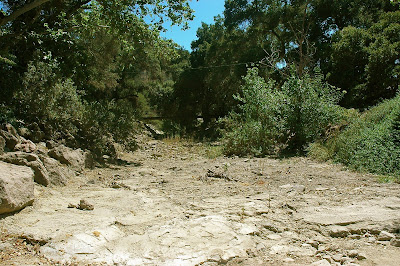
You'd think the California earth would protest more, would cry out for water, especially this far into a year with little rainfall to speak of, but it doesn't. Where there may have been desperation is only a calm, patient attendance, an acceptance of what is, a quiet expectation of what is to come. True to its boom/bust Gold Rush nature, California takes things in stride. The rains will come again, and once again, these creeks will be teeming with life-giving water, and the hills will be as green as Ireland's, as impossible as it seems now.

You and your companion don't have as much tolerance for the heat, however


and after a while, it was time to cross another hopeful bridge home.


Along the way, you found the greenbelt dotted with lavender bushes. Their scent always takes you back to another summer, one that folded into memory 20 years ago, the one which your older sister and best friend spent in the south of France, where she purchased for you a harlequin doll stuffed with lavender seeds.


The doll is long gone, but to this day, you can't pass a lavender bush without calling it to mind.

You stopped once more to appreciate this symmetry, purchased with your Home Owner's Association dues

and a neighbor's drought-tolerant yard featuring a gaggle of hens and chicks plants


and then you were home, where you were greeted by the cool of the brick floors and evidence that the rest of the family had already taken measures to beat the heat


as they waited for your return.

Digg this

Sunday, June 21, 2009

father's day #15

Fifteen years ago and some change, we started a family, a home-based business of sorts, complete with its own budget, mission statement, goals and objectives. Going into it, we knew that this company would never turn a profit, not as it stands. But that didn't make it any less worthwhile, didn't discourage us from making investments that, for the most part, won't start to yield dividends for a while still. No matter. It's not like we're flipping real estate or day trading. We're in this for the long haul, betting on futures we are only now just beginning to see the outlines of — just there, beyond the horizon.

We kicked off Father's Day celebrations at Peet's Coffee with pastries and frappuccinos,

then took the long way out to Highway 1, past a riot of bougainvillea lining the road like bull fighter capes, tempting the eye away from double yellow lines that somehow manage to keep order among four lanes of potential chaos.

It's easy to forget, living in a hot and dry valley — where canyons and traffic and the day-t0-day concerns of running four lives, and all that this implies, stand between you and the edge of the continent — it's easy to forget that the ocean is there, constant and faithful and tireless. Also, vast and beautiful and somewhat terrifying. You take the ocean on its terms, never the other way around.


It was windy but warm, and like the pelicans in the above photo, we spent some time perched on Nana Rock, the place where we scattered some of his mom's ashes, almost a year ago.


Then, in keeping with company by-laws, took a handful of Silly Photos to add to our collection of 16 years:


The wind chased us off the beach and back over the canyons, resting only long enough to catch its breath as we snapped this photo of a cactus clinging to the sandy side of a hill just off the PCH,


and these on a turnout on Kanan Road, overlooking Malibu:


Back through a tunnel with K.T. Tunstall on the stereo, the girls holding their breath and a wish

as gravity and gratitude pulled us down into the valley, back towards the home that he makes possible.

Tomorrow we'll get back to the business of running this family, balancing, negotiating, mediating. With little to go on, we'll no doubt be flying by the seat of our pants. But then, that's how we've always done it, and this side of the Pacific Ocean, we're still afloat. When we turn the control of their lives over to them and turn them loose on the world, it's probable that they'll find a way to do it better. In fact, you hope that they do. Because that's your benchmark, that's how you'll know that this whole endeavor was a success.

Happy Father's Day 2009, JMS.


Love,
PJ&J
Digg this

Monday, May 11, 2009

suspended animation

A couple of weekends ago, you took a trip to the nursery to purchase some annuals. On the face of it, buying the flowers was a necessity: the yard was starting to look long in the tooth, abandoned, as if its owners had already begun checking out, moving on. A sprinkle of color underneath the olive tree would suffice — some reds and whites and a dash of impatiens whose petals resembled an Orange Creamsicle seemed to make all the difference in the world. And while it was true that the neglected-looking yard did need sprucing up, the need to plant flowers went beyond aesthetic.

In truth, you needed to get your hands dirty. To immerse limbs, elbows-deep, into the soil. To feel the gritty earth under your fingernails and the breeze on your back as you knelt in the olive's shade and recommitted yourself to this place you call home.

Since August, you have been trying to restructure the mortgage with your bank so that you can keep the house, keep raising your children here, keep one foot in the community you crossed the country to be a part of. 2008 was a tough year for your family in every way, a year defined by loss and limbo — loss due to the death of your mother-in-law, the slow demise of a business, and with it, the majority of your savings that has resulted in a limbo-like state of existence, a place where you register sound through cotton-ball ears and observe things with blurred intensity.

The soil was rocky and root laden, and much less yielding than you had imagined it would be. You were surprised by this, taken back by the effort it took to dig a hole a few inches down and around, the way your hand cramped as it grasped the trowel. But what were you expecting? Sandy soil that submitted to the trowel's blade without protest so that you could cleave and dice to suit your intentions? Well, yes. But the displacement of the earth was only temporary, and for a greater gain. Once the flowers were firmly in the ground, all would be returned to as it had been, only now, where once there was only the dirt itself, there would be life. Color. Cheer.

And maybe that's what these past nine months have been about as well. A digging up, displacement, and turning over of the rocky bits, a slicing through of shallow roots, a clearing away of sorts so that something vibrant might take its place, however temporarily (the flowers are, remember, annuals, which means that in time, they will have to be dug out and replaced, too).

Who knows? From this vantage point, all you can do is observe, and wait, and appreciate. And while you'd prefer knowing, would welcome a clear path (stay? go? where? and when?), what you do know for certain is that objects in a state of suspended animation are supported. Something sustains them, keeps them functioning, alive, until it's time to reanimate.

You're waiting to be reanimated. To take root and thrive. To bounce with color and cheer. You know it's coming. This season will turn, and you will go on.
Digg this

Monday, March 23, 2009

jealous

You are jealous of Spring.

Every year at this time, you find her blushing at the thresholds of your doors, catch glimpses of her through your windows and screens, and the feeling returns.

She is vibrant and passionate and easy, Spring. Ready to get it on, to procreate, recreate, duplicate her beauty, to infuse everything around her with life and potential and the promise that all will continue on.

Spring greets the day before the sun has even decided it's time for another go 'round, and lingers long enough in the evening sky to make the thought of setting seem somehow misguided.

Spring is soft and loud and looks perfect in every shade of green, but especially the light ones. She is the life of the party, the belle of the ball, the first to arrive and last to leave. She is fast and loose and fragrant, and if you could bottle her, you would be the wealthiest woman in the world.

Instead, where Spring is light and lithe, you look lethargic. As Spring gets a jump on the sun, you pull the duvet up over your eyes and mentally bargain with the day for five. more. minutes. As she explodes on the scene in all her effortless, ineffable morning glory, you are busy scrubbing and exfoliating and rouging and tweezing, and worrying that you'll not get away with ignoring your roots for much longer. (Spring's roots do not have this problem.) And while she is busy filling heads with her fever, you are rifling through a tired wardrobe, deliberating between sweat pants or shorts, depending on how well your legs survived the winter.

But she's infectious, Spring, and eventually, eventually, she gets to you. And after a while, you find yourself rising with the sun and lingering at the end of the day, watching the shadows grow and wishing it could last. You grow lighter, and more carefree. You smile more at strangers, and take deep breaths of intoxicating air, and you're the better for it.

When this finally happens, when you feel vibrant and passionate and easy again, you know that you have caught Spring's fever, too. And little by little, jealousy gives way to something lasting and profound and true.

Something that looks a lot like gratitude.
Digg this

Thursday, March 12, 2009

(re)orientation

Last night was orientation for all incoming freshman at the local high school. "Surreal" does not describe the feeling of sitting on the bleachers in the gym, surrounded by pennants in Warrior colors and anxious, acne-ridden kids, doused in fluorescent lighting, knowing (but not yet fully comprehending) that you're here for your kid. Your baby.

Joining Facebook recently probably doesn't help, because it has brought an immediacy to high school — your high school — that you haven't felt in over 20 years. Friends, acquaintances, people you knew in passing, people you wanted to know — they're all there, suddenly, their lives open to you with the swipe of a finger across the track pad, looking just about how you remembered them, with kids of their own, and jobs and mortgages and... grown up stuff.

You loved high school, loved your classes and friends, loved going to the games and watching football practice, loved being a part of a community of people at a time when the world was right there, at your fingertips, waiting for you to explode into it, to wake up to your potential, to turn everything to gold with your touch, simply because you believed it was possible.

Now, it's your daughter's turn, and you want the same — better — for her. You want her to feel connected, unlimited. You want her to know the heartache of a major crush, and the comfort that comes with sharing that ache with a close friend. You want her to thrill at the smell of new textbooks and the first shavings from a pencil, and to know that it's okay to geek out over stuff like this. You want her to look forward to her classes and to find that teacher who will find something in her, and seek her out, and send her on a life path that she will follow until it's physically impossible for her to do so anymore.

In a matter of months, she'll walk that campus for the first time as a freshman, moving forward into her own future, little by little, moving away from childhood, more and more. Already, you're talking about what courses she should take to prepare for a UC school, which means that college will probably come faster than anything that's come before. She's excited and terrified and ready and reluctant, and so are you. Her orientation last night marked the being of yet another reorientation in your life, and all you can do is cross your fingers, take a deep breath, and say "thank you." For what is, what has been, and what is surely to come.
Digg this

Tuesday, March 10, 2009

finding the "recess" in the recession

Strange things have been happening recently, things that, just a few months ago, would have seemed impossible — assuming they would have ever even crossed your radar. Things that have brought a sigh of relief, room to breathe, a welcome break from the rat race.

In fact, the rat race? Someone called it. And it's over — if not officially and forever, at least for the time being.

And it's all due to the recession.

Granted, this global shift in the financial markets has been no picnic, and there are many thousands of people whose worlds have been thrown into turmoil (you yourself have seen your investments nearly wiped out this year). We've all tasted a heady cocktail of ignorance, greed, and an incapacitating fear, and know from experience that it doesn't go down easy.

But there is an upside to this downturn, something to be gained from staggering losses, insight after blind faith. Because in an unexpected way, after the dust has settled on the destruction left by the recession, and even sometimes when you're still in the thick of things, it is possible to take a break, take a breath, and take it easy for a while.

It's possible, in other words, to find the recess in the recession.

In your own experience, this global contraction has forced you to look at things differently, to prioritize, to examine your list of material "must haves." It's like reaching that age when you no longer care about keeping up with the Joneses, only you're 40, not 50 or 60, or whenever that usually happens.

And you're glad of it. Happy to just... stop for while. For the first time in a long time — maybe forever — you don't feel the need to have be do more. For the first time, you are content, and from this feeling of well being, you're now able to have be do more for others who are in far more dire straits that you, those who don't know where their next meal is coming from, those who feel helpless, hopeless.

You don't know how long it will last, this feeling of contentment, of things being set to right, of order amidst the chaos. But you do know that this recession — this recess — has definitely left its mark. And in a strange and unexpected way, you're grateful.

Readers: Have you been able to find the recess in the recession? Comments are open for sharing your thoughts.
Digg this

Wednesday, February 4, 2009

mean girls

It's been very much on your mind recently. You're 40, not 14, but you feel just as you did back then, now that your oldest is going through her turn in junior high.

It all seems so unnecessary.

The bullying, the name calling, the eye rolling. The comments about her clothes, the suggestion that she not curl her hair in the morning, as that look is the domain of the most popular girl in the eight grade. The additional suggestion that she try and "dress normal," that is, tone down who she is to become one of them.

It is all bullshit.

You pick her up every day from school, this tall, leggy, knock-out of a girl/child — the one who has been sketching clothing designs since she could hold a crayon, the one who now turns heads wherever she goes, and has the boys competing for her attention — and you know before she releases the latch on the door that it's been another one of those days.

The worst of the vitriol comes from the angriest of girls.

(Do they know how transparent they are to outside observers? Do they know that, with every sneer and cutting remark, they shed light on a self-loathing that is so profound it moves you to think about it?)

There's the one who was born with a defect, who literally wears her shame on her sleeve. She is a pretty girl, but awful. Just awful. Spiteful and mean and consumed. She has manipulated her world to work things in her favor, brandishing her handicap like a weapon, defying anyone to short change her the pity she thinks she deserves.

(Probably not. Or, not yet, anyway. They can't possibly have that level of self awareness. If they did, they would be incapable of such behavior.)

The problem is, your daughter doesn't buy it. She doesn't sing in her key, doesn't fawn over her and tell her how cute she's dressed today. This only infuriates the girl, strengthens her resolve to publicly bring your daughter down, no matter the cost.

(The problem also is, your daughter thinks that she is in some way responsible for how this girl treats her. That she somehow deserves the abuse. Daily now, you remind her that she is only responsible for how she chooses to interpret what is said and done. That she has the ability to respond in a way that favors her self esteem. You wonder when this is going to sink in.)

There is another girl, a plain, unremarkable girl whose smart-ass, fuck-you attitude will not serve her well down the road. Last year, you had the school place restrictions on how close she could come to your daughter. Yeah. Like that. It didn't stop the harassment. You knew it wouldn't. But you also knew that to not go to the administration, to not bring to their attention what was going on, was to send a message to your daughter that she was not to make waves, speak out, stand up for herself when faced with abusive behavior. It was an exercise in self respect, a lesson in discerning what is and what is not acceptable in the big world.

Especially when it comes to being a woman.

These two are among the aggressors. There are others, the followers, those who stand idly by as the verbal vomit happens. They are perhaps the most disappointing, because you know some of them. Know their parents. Have carpooled with them, given them birthday gifts, watched them grow up. Where is their loyalty? Where is their own sense of self respect? Where is that little voice that reminds them that it is absolutely unacceptable for any girl, no matter what her social standing, to belittle another?

Of course, rationally, you know the answer, know about herd mentality, understand the stakes involved in standing apart from the pack. And you know these kids are probably doing the best that they can with the tools that they have. And so you smile at them when you see them, and wait for them to mature, and hold your daughter close after the day's storm has passed.

The others... Long after you've forgotten their names, or are able to place their faces, or even recall the harmful exchanges, long after your daughter has grown and matured and stepped into womanhood in the way you know she is capable of doing — will eventually do — these girls will probably still be there, in their eighth grade mode, with their petty judgments and massive self loathing.

Unless.

Unless grace happens. Unless something moves them, from within, or without. Unless their lives are shattered in such a profound way that to pick up and rebuild with what they had would make no sense. Better to start from scratch, from a new understanding, or from zero understanding, but a willingness to go from there.

And grace could happen. It's there. It's always there, waiting for any and all comers. Maybe your daughter will be the catalyst for grace. Maybe the dance that she's performing with them will be the turning point. Maybe in her graceful approach to getting through these last few months of junior high, head up, shoulders back, self esteem shaken but not destroyed, grace will move and find momentum.

You hope and pray that this is so. Because no matter how often you wish you could slap them around, mean girls need grace the most.

(Come to think of it, you could use a cupful yourself.)
Digg this

Monday, January 26, 2009

40 under 40


Saturday, and it's your 40th. You wake up to breakfast in bed, and two kids who think that birthdays are the coolest. thing. ever.

You don't mind the thought of being 40. In fact, you -- the wiser, more relaxed, more experienced you -- are actually looking forward to it.

(Oprah claims she hit her stride when she reached 40.)

(Which is all the more reason to jump in with both feet. Right?)

You're not much of a list maker, but at this junction, maybe a little shorthand recollection is a good idea. Like a mental measuring stick. Or a protractor. But not the metal kind, like you buy at Staples. The kind you're thinking of is the one you made with your hand, as a kid. You know, where you planted your thumb on the anchor point, then used your index finger to estimate your calculation.

This list is like your hand protractor: Start right... there. No -- over just a bit. There! Put your thumb right there. Perfect. That's your starting point. Now, hold your thumb steady and with your index finger, draw an invisible circle, as far around as you can make it go. That's right. Inside that invisible circle? That's what you've done, as well as what you've left undone. And from here, you can begin to plot out the next 40.

Here goes.

In your first 40 years...

1) you married one man
2) had two children, two businesses
3) and three mortgages
4) you closed one of the businesses after reaching your financial goal
5) you found an investor for the other business to help take it to the next level
6) just before Lehman Bros. collapsed, forcing you to put fast-track growth plans on hold
7) you did not go to kindergarten
8) except for that first day, when you decided that you'd rather stay at home and play with your little brother
9) but did eventually attend 10 different schools by the time you graduated high school
10) you grew up in a military family (hence number nine, above)
11) with five brothers
12) and three sisters
13) lived on Guam (number 10, above)
14) as well as in Oxford, England -- your choice
15) visited 28 or so states, at last count
16) and traveled abroad to Poland
17) and Portugal
18) and were asked to go to Paris to serve as editor-in-chief for an American youth magazine, an offer you declined because you were in love (see number one, above)
19) you played bass in two bands
20) wrote six screenplays
21) one of which has been optioned three times
22) two of which were developed by the A-list prod. co. responsible for Legally Blonde and 10 Things I Hate About You, among others
23) published articles in magazines and newspapers, and on the Internet
24) have been featured in Writer's Market -- a New York Times annual bestseller for aspiring writers
25) the same publication you have used since forever to pitch articles (see number 23, above)
26) you began writing your first novel, which you hope to pitch this spring
27) corresponded with Elie Wiesel on the subject of your novel, before it was a novel
28) wrote a two-act stage play
29) and helped to launch four grade school musicals
30) with the fifth one on its way
31) you studied to be a Third Order Dominican
32) before becoming completely disillusioned with organized religion
33) which actually strengthened your faith
34) you buried father-in-law
35) and, 14 years later, your mother-in-law, though not with your own hands
36) you started a chapter of Amnesty International in high school
37) and are still an active campaigner
38) you also stood out in the snow with your husband and two small children to protest, pre-invasion, the Iraq war
39) worked with Bobby Shriver
40) and cried like a baby when Barack Obama won the presidential election (!)

Okay, so. Fair enough. A good start. But it's nowhere near what you want to accomplish before you die.

Time to roll up the sleeves and get to work. Because you're expecting big things from the next 40 list, the 40 Over 40.

Tick, tock.
Digg this

Wednesday, January 21, 2009

sexy boots (no line on the horizon)

Satellite radio in the car tuned to a pop station in the U.K., where you know the new U2 single will be on heavy rotation today, you wait for it: "Get On Your Boots," the first single from U2's newest offering, No Line on the Horizon, which has been four years in the making.

You wait for the song, then you wait for your impression of the song. It's been a long time, after all, and you want to savor the experience. Want to mark the date time place that it happened to you, this go 'round.

You've been with the band since just about the beginning. A freshman in high school is about as far back as you can remember understanding that it would be their music that made up the soundtrack to your life, but it could have been before then. Anyway, high school, and your sister discovered them first, gave a copy of the Boy album to Todd Gardner for a listen. He returned it a few days later with a "meh," and a shrug of his shoulders. You bet he's a die hard fan now.

So many years on, and you want it, this new album, to matter just as much as every other one before it has. Because U2 has always been the music in you, and you're afraid that if they don't matter anymore, then one of a few things has happened: They've either run their course (unthinkable), you've moved on (unimaginable), or you just don't care like you used to. Which, if you think about it -- if they've always moved you, have always been the back beat to your experiences, the metronome by which you mark your memories -- is kinda sad.

Because where are you then, when the soundtrack to your life goes mute, or stops playing altogether?

In "Get On Your Boots," you hear some familiar U2. It's not apparent at first, and then it is. Also some Beatles references? Maybe? The rest... you're not sure of yet. You'll take your time to make up your mind.

What you do like, at first pass, is this:

Women of the future/Hold the big revelations, and this: You don't know how beautiful you are, and this: Let me in the sound.

Which is exactly what you are wanting to happen, too.
Digg this

rain, dry spells, and empty wells

Rain moves you. Makes you want to create. To sit in your office, classical music on the iTunes, and write. Something profound. Poetic. Something that might move others, just as the rain moves you.

Rain features heavily in works of longing reaching redemption.

(Does this, by extension, mean all of your stories take place on rainy days?)

Songs about rain abound. Songs about singing dancing walking in the rain.

In movies, epiphanies happen in the rain. So do break ups, make ups.

(Yes, come to think of it. Or, a good many of your stories, or scenes within them, anyway.)

Rain evokes place, the poetry of places discovered, or yet to be. Maybe that's what makes the Irish, with their rains-every-day island, the poets that they are, or were. Yeats. Joyce. Swift. Wilde. And, following in their footsteps, Frank McCourt, U2. Even Lennon and McCarthy, both of whom were Irish grandsons. However they express it, whether through song or story, they are all, in the end, poets.

There are others, of course. Many others. Too many, after all, to count.

3pm on a Wednesday in SoCal, and you're waiting for the rain. Waiting for the inspiration that will come with it. Waiting to create. Bernstein wrote, "Inspiration is wonderful when it happens, but the writer must develop an approach for the rest of the time."

This is your rest of the time. This is your approach, what you use to jump-start the muse, maybe, if she exists, and if she's amenable to being jump started. Which you doubt.

But it's rare when it rains in this part of California, so you know to take Bernstein's observation to heart. Because most of the time, it's a desert out here. Dry and arid and... yeah. Dry. Which means that, if you're waiting on the rain alone, your well of inspiration's gonna run dry, too.
Digg this

Monday, January 19, 2009

piano lessons

Thirty years ago, you took piano lessons. You don't remember how long you kept it up, or if you were any good (except that your teacher told you you had "obedient fingers," for what it was worth), only that you approached the piano like you approached everything back then: with lists and schedules and the expectation that if you just applied yourself enough, and were disciplined enough, you would succeed.

For better or for worse, you use that approach to this day.

Working now on a piece of fiction about a young girl first setting out on a career in classical music, you are challenged to capture the essence of the piano lesson on paper, to evoke what it is like to not just play the instrument, but to experience it at the most basic level, where the senses are engaged. To place the reader on the piano bench, sheets of practice music at the ready, hands in position.

Your first pass at that exercise looks something like this:

"
For her, the piano was an experience, something that was to be played and listened to, yes, but also understood on a tactile level — inhaled and stroked and consumed with the eyes. Finally, it was something that evoked memory and place, and longing and struggle and mastery, such that in the end, the entire experience was complex and complete, and infinitely satisfying.

She loved the high polish of a grand piano, loved that her image was reflected before her as she played, herself but not her Self, her emotions and expressions and clumsy and perfect fingering all mirrored back to her simultaneously, as though the experience was worth double the expression.

She loved the feel of the keys under the pads of her fingers, the cool of the ivory, long and flawless and weighted to precise specifications, and the shorter, angular black keys that her fingers sought out without assistance from her eyes, sliding over the front or side of each as she played them.


But most of all, she loved its smell, the warm, dusty, secretive scent that was immediate and intimate. Enveloped in an olfactory experience that was at once earthy and synthetic, she felt the world to be — literally — at her fingertips.


There was the intoxicating smell of coated veneer and zesty furniture polish that lingered in wood knots and felt fibers and the grooves of tightly-wound piano wire.


There was the warm and musty scent of felted wool, and the robust combination of a forest of wood from which the body of the piano, from legs to ribs, was constructed — spruce and maple and birch and walnut and sugar pine — as rich and comforting, as earthy and edible and elemental as anything she knew.

There was the tang of metal, of brass pedals and iron piano wire, heavy and solid and sustaining, like the depths of the earth from which they were mined.
"

And so it goes.

When you were ten, your mom drove you once a week from northern Marin into San Francisco, where you took lessons at the Flood Mansion on Broadway, in Pacific Heights. Twenty-nine miles and some change, each way, covering the entire length of one county and venturing well into another, to sit in that glorious building overlooking the Bay and wait your turn with the metronome.

Back at home, schedule in hand, you practiced your scales and Bach movements and the Beethoven etude (the one he composed for his wife), but with the mute on. Always with the mute on. House rules.

Looking back, you wonder at the lengths (driving to the City) and limitations (practicing with the mute on) involved with this time in your early development, and wonder if you don't unintentionally impose the same opposing conditions on present day aspirations. Could it be that you still set out with the best of intentions to obtain, experience, absorb at the highest level, only to put a damper on things in the in between times, when discipline and practice and just showing up ultimately serve to bridge the distance between dream and reality?

And if you believe that the world rests at your fingertips, then it certainly must be time to reconfigure the old approach, to not only cast your intentions as wide and far and high as you might dream, but to also ease your foot off the mute pedal so that you can experience every clumsy and perfect note you play con affetto — with emotion — and out loud. Very much out loud.
Digg this

Friday, January 16, 2009

firsts (the second part)

With the third trimester came the count down, the impatient toe-tapping, the ready-to-be-done feeling that kept you up at night, too uncomfortable to sleep in any position. Even though you were exhausted. Even though you knew you would be even more exhausted after it was all over.

You remember your first contraction, the slight ping of discomfort, and the nerve-wracking watching of the clock, waiting to feel something — anything — that might resemble another one. You didn't know. You had no idea that when the birthing process started in earnest, there would be no second guessing, no wondering if what you were feeling was curry-induced heartburn, or It.

You remember the day your husband purchased a beeper so that you could be in touch immediately. And you remember how, over time, as the baby growing inside of you made a big show of dropping into position, and then... nothing, not for another two weeks, you developed your own beeper shorthand — shorthand you use to this day, fifteen years on — exchanging numeric pages only the two of you could interpret.

You remember your first trip to the hospital when you were sure the contractions were for real this time, and the crushing disappointment you felt when they sent you back home with a checklist of signs and symptoms, and telephone numbers to call when things got serious. You remember your last visit to the OB, where you told him you were too tired to carry this child anymore, and begged to be induced.

And so you were, and so she came into the world in the middle of November on a crisp, cool day, a day much like the one some forty weeks earlier when you first began to grasp how complex the simple equation "two plus one is three" can be.

You'd think you'd remember more of the birth itself — the Pitocin, the hours of labor, the fact that you squeezed your husband's hands so tight with every contraction that he had to remove his wedding band. And while there are moments like these that stand out, what you most remember is the first time you held her, the first time you saw that swath of jet-black hair and her perfect, beautiful face. You remember wondering at how tiny she was, and how, just minutes after being born, she grabbed hold of your index finger with one hand, and held on tight.

And you remember the look on your husband's face as the nurse handed the baby to him, and how he cradled her in his arms, and rocked gently, back and forth, whispering her name, "Johannah."

Johannah would bring a world of firsts. Fifteen years on, and she still surprises. Now more than ever, as her next round of firsts looms (first car, first boyfriend, first prom, first job), reminding you of your own similar firsts (and how can it be time for her to experience these events, when it seems that you only just left them behind?), you feel a little out of control. You're not yet confident you can pull it off, this next phase of firsts, and you want time to feel your way.

Just like you did on that first day.
Digg this

Monday, January 12, 2009

firsts (the first part)

There are many firsts in a life, of course. Some you'd just as soon forget, but most that you are happy to remember.

Like a first kiss. Or the first time you saw the man that would one day be your husband. Or the day you first realized that you were carrying a child.

The first time that happened, you were still a student at the University of San Francisco — an older student (at 24) paying your own way through.

You had purchased a pregnancy test at a drug store near school, then taken it in a pink bathroom stall in the women's on Lone Mountain. Where you alone saw the pink line of confirmation, the pink line that drew the line between your then and your now, and all of your tomorrows. Little did you know that pink would be a recurring theme in the days and years ahead.

After, climbing the steps to your Logic class, you stopped on the landing, oblivious to the other students rushing to get to their next class, aware — very aware — that your life had suddenly, instantly, and irreversibly changed. Forever.

The confirmation came from the doctor's office a few days later, and when you called your husband, you broke down in tears. It wasn't supposed to happen like this. You two had it all planned out. You wanted a few years together, to be a couple, to be 20-somethings, to just... be. You weren't yet confident you could pull marriage — let alone parenthood — off, and you wanted time to feel your way.

Six months into saying "I do," and did you ever.

You picked your husband up early from his office downtown, the January sky an electric blue above the canyons of tall buildings in the Financial District, and cried some more on the drive back home. "We'll be okay," he kept saying, overwhelmed and excited and scared to death. "This is a good thing."

And you were, and it was.

You remember the first trimester, the nights when you fell asleep as soon as your head hit the pillow, the morning when suddenly, your favorite pair of jeans no longer fit. You remember the first ultrasound, where you and he saw something that resembled a baby, and heard the heartbeat. That unforgettable, underwater sound that let you know that life was growing thriving becoming inside you.

You remember the second trimester, the time when the secret you and your husband shared was visibly, officially, out of the bag. You remember the first time you felt your child kick, on a plane from San Francisco to Louisville, to attend your father-in-law's funeral. You remember the first pang of regret that someone close to you, someone whose own DNA would be replicated in the child you were carrying, would not be there to share in this new life, to watch it grow and thrive and become. You remember looking down at your swelling belly, seven months into the process, and wondering out loud how you were ever going to get that child out.

Firsts (the second part), next blog.
Digg this

Saturday, January 10, 2009

installation

It's impossible to take it all in.

The Getty Villa, Malibu, at the edge of the continent. It's a perfect day — remnants of fog from the ocean, but mostly flawless blue sky, and warm, mid-70s warm — and you and a handful of other visitors, plus the docents, have the run of the place.

You can't possibly take it all in. No matter how you try, there's just too much there to gorge the senses on. You have your limits.

The first indulgence, the obvious one, is the antiquities collection: The David. Athena. Jewelry and pottery shards. Maybe it's the energy of the archetypes that overwhelms you, their power and promise, resonating in you. We all respond to archetypes, some harmonizing with us more than others. They are part of our collective story, the one that reminds us we are both human and divine.

But more than the collection, you are intrigued by the architecture, the flesh and bones of the place. At the Villa, the wall sconces and marble columns and color palette are every bit as engaging, and you understand that nothing less than this would do to hold such massive works of human achievement.

In earthen vessels, wealth untold.

A temporary installment, the work of pop artist Jim Dines, holds your attention for almost as long. There are the wooden sculptures of the Greek statuettes of dancing women, painted wood female figures Dine has reinterpreted from his vantage point. And there is the sculpture of the poet's head, massive in the center of the room, every feature and flaw writ large for inspection.

But it is the poetry on the wall that catches your attention, the charcoal inscription of the verses of "The Flowering Sheets," in Dines' own hand, read on a loop in Dines' voice, that stops you. So you stand among the sculptures, diminutive next to the dancers and the artist's head, and read along with him, getting into his brain, thinking his thoughts, seeing things through his eyes.

It still hasn't settled in yet, the experience. And there is more to experience that you had to leave behind. Like after a decadent meal, in which you push the plate away reluctantly, knowing there is more to savor, knowing, too, that one more bite will ruin the entire evening. You leave wanting, until you realize that you already have it all.

Next time, when you've cleared some space and made room, it'll be there. Apart from sharing his collection, Mr. Getty has also shared something of equal value to you: The realization that great wealth is possible. The understanding that money is not, as you were led to believe, the root of all evil, but, in fact, a blessing. And the dawning idea that you have some major reconstruction to do — the excavation of a few deep-seeded beliefs, the installation of others that will better serve you, down the road — if you are going to be able to take it all in, to house the wealth of treasure you're only just beginning to awaken to.
Digg this

Monday, January 5, 2009

why do you write?

You write because it's one of the few productive things you can do in bed, without reproducing.

You write because you love words, the shape of them, the way they fall on the page, with left-justifieds and ragged rights. You love the shape of the letters within the words themselves, like how the 'd' and 'b' in "bedbug" stand back to back, mirror images of each other. You love the incongruent pairing of words, like "horseradish." And you love words that sound like what they mean, like "tintinnabulation." Especially "tintinnabulation."

You write because you want to find the through line of your own life story. It's like a big, messy ball of yarn at this point, your through line, a ball that will demand your full attention at times when you wrestle with the tangled and thread-bare parts. At other times, the yarn will give way with a simple tug, and it will be easy to see where it begins, and where it ends. But more often than not, you'll be wrestling and detangling. Writing is that unravelling process that helps you tease out the knots. If you're patient, what you're left with, the through line, can then be made into something of value. Something for yourself that you can use to keep warm, or something for someone else, to be given as a gift.

You write because you remember. You remember that sixth grade paper, the one where you wrote a morality story about two characters named Choosey and Chances, the one Mrs. Rushton awarded an A +++ with big red, enthusiastic letters. You remember your eighth grade teacher, Ms. Nu, the one who was in love with Carl Yastrzemski, the one who encouraged you to enter an essay contest commemorating the anniversary of the Golden Gate Bridge. And you remember two college profs who encouraged your talent (Dr. Leiva) and challenged you to do something with it (Dr. Alyeto). You remember, and you honor them with your writing.

You write because you don't want to take anything for granted, the day-to-day details, the life-changing events. You want a record. Something to jog the memory down the road, something to show for the minutes and hours, the days and weeks and months, the years that you spent breathing and taking up space, also loving and giving of yourself.

You write because it's mostly hard to do well, and you love a challenge, but also because you love those rare instances when the page opens up for you, the words come, of their own volition, and line themselves up -- a perfect assembly of left justifieds and ragged rights, and all shapes and sizes and manner of words this consists of.

Most of all, you write because it keeps you sane. It keeps you on an even keel. It makes you a better wife/mother/human. And considered from this perspective, you write because you have to.
Digg this

sleeping pill

She is like a sleeping pill.

He leaves the bed every morning at 5:45, throwing back the layers of duvet and afghan and top sheet, inadvertently inviting the biting cold in. He's good about it, though. Before he hits the shower, he'll make sure the duvet and afghan and top sheet are all back into place, make sure that you are warm and safe until it's your turn to face the morning chill.

5:50, and the shower is running. This is what must wake her. The sound of the shower, or the fan he turns on to whisk away moisture that, if left to cling to the marble and glass, will encourage a colony of mold to take up residence. The fan is necessary, but loud, and it's probably what stirs her from her underneath her own duvet, in her little bed at the other end of the house, what sends her running through pre-dawn darkness down the carpeted hallway.

Now it's her turn to throw back the covers, but you don't mind. She is like a sleeping pill. Spooning you with one arm wrapped across your waist, knees tucked up into your wheelhouse, she is warm and soft and delicious, and within minutes of the interruption, you drift back to sleep, knowing that this next hour will be the best of the night.
Digg this